Field Guide · Japanese Fashion

Japanese Avant-Garde Fashion: A Field Guide

Most fashion asks you to follow.
Japanese avant-garde asks you to decide
what you actually stand for.


In this article, you will learn:

  • What Japanese avant-garde fashion is and where it comes from
  • How it looks, who made it famous, and how it differs from mainstream fashion
  • How to actually wear it — practical styling rules and product references

What is Japanese Avant-Garde Fashion?

The word avant-garde comes from French military vocabulary — the soldiers sent ahead of the main force into unknown territory. In fashion, it means exactly that: work that moves ahead of where the culture currently is.

Japanese avant-garde fashion is a design tradition rooted in questioning every assumption mainstream fashion takes for granted. Proportion, silhouette, colour, the relationship between body and garment — nothing is fixed. Everything is open.

Japanese avant-garde layered hakama pants with ink print — Kón
Layered Hakama Pants, Ink Print — Kón

The movement emerged in the late 1970s and early 1980s, when a generation of Japanese designers brought work to Paris the Western establishment had never seen before. Dark. Asymmetric. Deliberately unfinished. Critics called it Hiroshima chic. The designers kept working anyway.

Where most fashion exists to flatter, to signal status, or to fit a current moment, avant-garde fashion exists to challenge. It asks: what is a jacket? What does a sleeve do? Why does a collar need to be there? And then it answers differently.

Key Characteristics of Avant-Garde Style

Avant-garde fashion is easier to recognise than to define. Several characteristics recur consistently across the work.

Split-front tailored hakama pants — Kón avant-garde collection
Split-Front Hakama Pants, Tailored — Kón
  • Silhouette over trend. The shape a garment makes in space — not what other brands are doing this season. Volumes exaggerated or eliminated.
  • Monochrome, usually black. Not a colour choice. An argument. It removes distraction and forces attention onto structure and form.
  • Asymmetry and irregularity. Uneven hems, single-sided collars, unexpected cuts. Symmetry is a convention, not a law.
  • Anti-body construction. Garments that wrap, obscure, or transform the perceived shape of the wearer. The clothing is not decoration for the body — it is its own object.
  • Deliberate incompleteness. Raw edges, visible seams, deconstructed construction. These are statements, not accidents.
  • Absence of decoration. No logos. No embellishment. Nothing that does not serve the concept of the garment.

The silhouette that defines this tradition

Explore Hakama Pants →

Influential Japanese Avant-Garde Designers

The tradition is associated with a small number of designers whose work defined what Japanese avant-garde fashion became — and whose influence continues to shape independent design today.

Yohji Yamamoto

Probably the most influential figure in Japanese avant-garde fashion — and one of the most significant designers of the twentieth century by any measure.

His philosophy is inseparable from his work. His clothes are almost always black. His silhouettes are large, asymmetric, wrapped — they resist the body rather than celebrating it. The oversized cut, the covered form, the refusal of exposure: these are positions, not just choices.

His collaboration with Adidas — Y-3 — introduced his design language to a wider audience. But his main line remains the reference: dark, severe, beautifully made, and entirely indifferent to what is fashionable.

Rei Kawakubo — Comme des Garçons

Rei Kawakubo founded Comme des Garçons in 1969 and has never stopped pushing at the boundary of what fashion is allowed to be.

Her Paris debut in 1981 was genuinely disruptive — dark, asymmetric, layered, featuring deliberately distressed fabric that critics could not process as fashion. She received it as provocation. She kept working.

Where Yamamoto works in philosophy, Kawakubo seems interested in the concept itself — garments that challenge whether the category "clothing" applies at all.

"Together, they established that fashion could be simultaneously commercially successful and completely uncompromising."

Issey Miyake

Miyake's contribution is the most technically distinct. Where Yamamoto and Kawakubo work in drape and deconstruction, his practice is rooted in material innovation and the relationship between technology and craft.

His Pleats Please line — permanently pleated garments that maintain structure through washing and travel — is a design argument about functionality and permanence. His A-POC concept (A Piece of Cloth) takes it further: entire garments cut from a single tube of fabric, the wearer deciding the final shape.

Avant-garde tailored hakama construction detail — Kón
Split-Front Hakama Pants, Construction Detail — Kón

How Avant-Garde Fashion Differs from Mainstream Fashion

The differences are not just aesthetic. They are structural — rooted in different assumptions about what fashion is for.

Mainstream fashion operates on a seasonal cycle. Trends are identified, consumers buy, and the cycle repeats. What is fashionable this season is designed to feel unfashionable next season. The logic is economic: turnover drives revenue.

Avant-garde fashion rejects this logic entirely.

  • The work is not designed to expire
  • A Yamamoto coat from 1984 is not dated
  • A Comme des Garçons jacket from a decade ago reads the same way it did when it was made
Wide-leg hakama pants — Japanese avant-garde fashion by Kón
Wide-Leg Hakama Pants, Tie Waist — Kón

Mainstream fashion is primarily concerned with the wearer's relationship to their body — fitting it, flattering it, signalling status through it. Avant-garde fashion is primarily concerned with the garment as an object in its own right, and with the wearer's relationship to their own sense of self, separate from social approval.

That is, for some people, exactly the point.

How to Style Avant-Garde Fashion (Practical Guide)

The mistake most people make is treating avant-garde fashion as costume — assembling extreme pieces for maximum impact. The goal is coherence, not drama.

Asymmetric oversized shirt — Kón Japanese avant-garde
Asymmetric Oversized Shirt, Avant-Garde — Kón
  • Start with proportion. Wide volume below, draped or close above — or the reverse. Get comfortable with unusual proportions before adding complexity.
  • Commit to a restricted palette. Black removes colour as a variable. Introduce variation through material: matte cotton, rough linen, heavy wool.
  • One statement garment per outfit. A dramatic cut is more powerful when everything around it is simple. Let the statement do its work without competition.
  • Fit to your actual body. Garments meant to wrap, drape, or hang should do exactly that. Do not alter volume-heavy pieces to fit more conventionally.
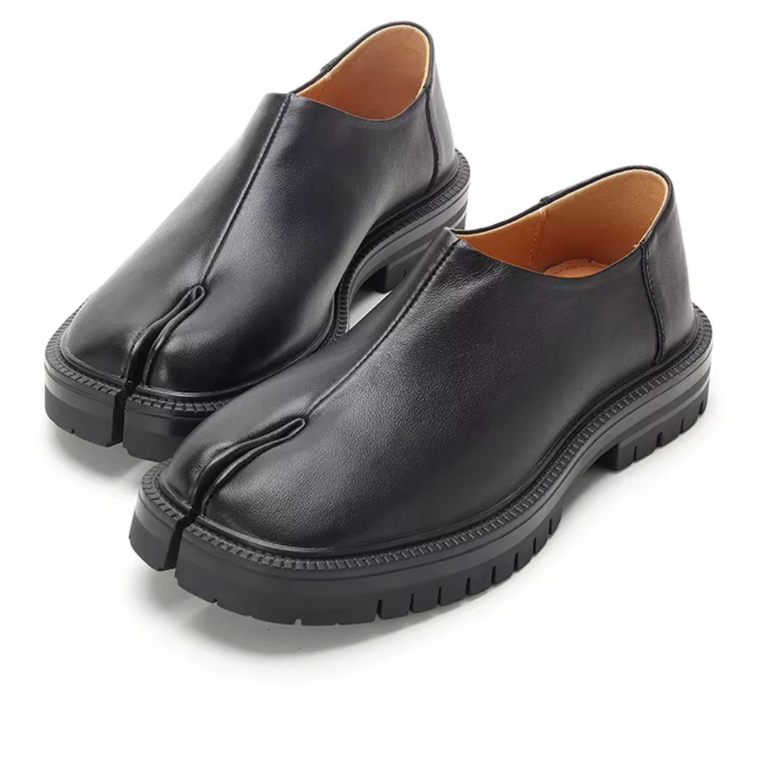
  • Footwear as structure. The shoe completes — or breaks — the silhouette. Chunky soles and architectural platforms work. Conventional shoes do not.
  • Remove before you add. When an outfit feels like too much, remove something. Avant-garde dressing is improved by subtraction.
Wide-leg hakama pants tie waist — Kón

Featured piece

Wide-Leg Hakama Pants
Tie Waist

View product →

A structured wide-leg piece like this is one of the cleanest starting points for this way of dressing. Pair it with a minimal top and architectural footwear — the silhouette does the work.

Hakama styling detail — Kón Hakama styling detail — Kón
Split-front tailored hakama — Kón

Also consider

Split-Front Hakama Pants
Tailored

View product →

For a more tailored interpretation — sharper construction, more versatile across contexts — the split-front hakama offers the same dramatic silhouette with greater precision.

Browse the full Japanese streetwear edit

View Collection →

Frequently Asked Questions

Is avant-garde fashion wearable every day?

Yes — more wearable than most people expect. The confusion comes from seeing it in editorial contexts, where styling is maximised for visual impact. In practice, the same principles produce garments that are often more comfortable than conventional fashion. Volume-heavy cuts move well. The difficulty is almost entirely perceptual.

What defines avant-garde style?

A refusal to accept fashion's existing assumptions as given. Silhouette over trend. Construction over decoration. The garment as an object with its own logic, separate from whatever the market is currently offering. In practice: unusual proportions, monochrome palettes, and garments that interact with the body in unexpected ways.

How do you style avant-garde outfits?

Build around one primary garment and keep everything else restrained. A single statement piece is more powerful when the pieces around it are simple. Commit to proportion before adding complexity. Work in a restricted palette. Remove before you add.

What is the difference between Japanese and Western avant-garde fashion?

Western avant-garde often works as provocation within an existing tradition — it references what it subverts. Japanese avant-garde comes from a fundamentally different aesthetic root: one that already valued negative space, asymmetry, and imperfection as primary virtues, not as rebellions. The result is design that does not feel reactive — it feels complete in itself.

Where do I start building an avant-garde wardrobe?

With a single silhouette. Choose one dramatically proportioned piece — a wide-leg pant, an oversized draped jacket — and build around it in black. Master the proportions before adding complexity. The hakama silhouette is the most natural entry point into this tradition.

Start here

Explore the silhouette that defines this tradition at Kón

 Explore avant-garde fashion collection→
Zurück zum Blog